Mont Ventoux or Stelvio: Which Mountain Is Really Harder?
Mont Ventoux vs Stelvio — ask ten cyclists which climb is tougher, the Giant of Provence or the Queen of the Alpine passes, and you’ll get ten different answers. Both are legends, and both appear on every serious cyclist’s bucket list.
Most articles online about these climbs are written by ex-pros or hobby cyclists with exceptional power on the bike. Their tips work brilliantly if you have their legs. This article is different. It’s written for you, the ordinary rider.
Your bike doesn’t cost equivalent to a car. Perhaps you are not in shape as you could be. You haven’t ridden as much as you planned this year. Maybe you were ill, maybe work got in the way, or maybe, if we’re being honest, you were just a bit lazy. Hill training? You couldn’t even manage “a couple of times”, if that. The racing bike has spent more time in the garage than on the road.
And now the mountain is calling, and the weather forecast looks perfect.
So what do you do? Stay at home because you’re “not fit enough”? Or say: heck, the sun’s going to shine, let’s go cycling!
I chose the second option, twice. And I learned that you can make it up both mountains, on your old bike, even without perfect preparation, if you know the secret. More on that in a moment.
Having ridden both, I also have an answer to the big question. But it may not be the one you expect, because the hardest part of a mountain isn’t always the gradient. Sometimes it’s what you see in front of you.
Ventoux against cancer
I rode Mont Ventoux on the same day as the Dutch charity event Groot Verzet tegen Kanker. For years, the Dutch Mont Ventoux foundation has organised a yearly climb in which walkers, runners and cyclists take on the mountain to raise money for the fight against cancer. The idea is simple and powerful: the climb stands for the fight against the disease.
The project started in 2007 when René Gaastra, suddenly diagnosed with brain cancer, asked friends and supporters to help him climb Mont Ventoux. In the first year, 45 cyclists answered his call. Today, the event brings together hundreds of people and has raised a great deal of money for cancer research.
Riding up the mountain that day was different. Next to you were people riding for a mother, a brother or a friend, or riding for themselves. Some were on expensive racing bikes, others were walking or running, and everyone was pushing hard. When you’re suffering on a steep section and the person next to you is wearing a photo of someone they’ve lost, your own tired legs suddenly feel less important. Plus the Dutch have a sense of humour, and you managed to share a joke or two duwing the climb.
The secret: a low heart rate
As on the Stelvio, the secret was the same: keep your heart rate low. Keep your ego in check, don’t worry about who’s passing you, and focus on just one number: your own heart rate.
Mont Ventoux is especially brutal for anyone who starts too fast. The first kilometres from Bédoin are gentle and lure you into a pace you can’t hold. Then the road turns into the forest and the gradient hits around 10% for kilometre after kilometre. Anyone who has gone into the red by then pays for it all the way to the top.
Ride slowly at the bottom. Slower than you think you should. Ride slowly in the forest, so slow it feels painful to watch. Advantage: you’ll still have something left when you reach the white moonscape below the summit.
A pause at the summit
This time, my only stop was at the top. I leaned the bike against the wall, caught my breath and just watched. Then a roar came out of the sky: a French Air Force Mirage fighter jet rolled lazily over the summit, right past the tower, as if it too had come to see the view. For a few minutes there was nothing to do, nothing to prove, just the mountain, the jet and the sky.
Two mountains, two histories
Mont Ventoux: the Giant of Provence
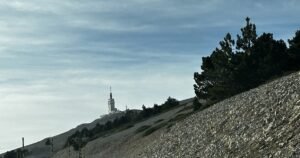
Mont Ventoux rises alone above the Provence countryside, about 20 km north-east of Carpentras. Its history goes back centuries. In 1336, the Italian poet Petrarch climbed it, and many consider this one of the first recorded mountain climbs for pleasure. A chapel was later built at the summit, and in the 1960s the famous red-and-white telecommunications tower followed, which today you can see from far away on the climb.
In cycling, Ventoux is a myth. In the 1967 Tour de France, British rider Tom Simpson collapsed and died just below the summit. A memorial near the top still reminds every rider of that day. Since then the mountain has written Tour history again and again, from Marco Pantani’s attack in 2000 to the women’s Tour de France in 2026.
Stelvio: the designer of the impossible
The Stelvio Pass is a completely different kind of legend. The road was built between 1820 and 1825 by the Austrian Empire to connect Lombardy with Austria. The engineer behind it, Carlo Donegani, managed something many considered impossible: a road over a 2,757-metre pass, carved into the mountainside with 48 numbered hairpins on the Prad side alone.
Cycling history arrived in 1953 when Fausto Coppi crossed the Stelvio for the first time in the Giro d’Italia and broke Hugo Koblet. Since then, the highest point of every Giro has been called the Cima Coppi in his honour. Hardly any climb in the world has been photographed more often than the Stelvio switchbacks.
Mont Ventoux vs Stelvio: which one is harder?
On paper, it’s close. From Prad, the Stelvio has about 25 km and roughly 1,850 metres of climbing. From Bédoin, Ventoux has about 22 km and around 1,600 metres, but with a long, relentless forest section at about 10% and the risk of brutal wind on the exposed summit.
Physically, the two are closer than most people think. The real difference lies somewhere else: in your head.
Ventoux: space to breathe
Mont Ventoux is wide. The road is broad, the curves are long and sweeping, and above the tree line the whole landscape opens up. You can see the summit tower far ahead of you, sometimes discouragingly far, but there’s space all around. You have room to move on the road, and you have room in your head.
Stelvio: the wall in front of you
The Stelvio feels completely different. Down in the valley you look up at a sheer wall of rock with a road zigzagging up it, line above line. The bends are tight, short and steep. Every few hundred metres you turn around a hairpin, and the next one is already waiting above you.
That wall in front of your eyes is the hardest part. On Ventoux you see the summit in the distance. On the Stelvio you see every single metre you still have to climb. Mentally, that makes the Stelvio feel harder, even when your heart rate says otherwise.
My verdict: Mont Ventoux vs Stelvio
- Physically: the two are close. The Stelvio is longer and higher, Ventoux steeper in the forest and more exposed to wind.
- Mentally: the Stelvio is tougher. The tight hairpins and the cliff wall in front of you weigh more heavily than Ventoux’s wide, open road.
- The key for both: a low heart rate. Whoever starts slowly arrives at the top.
The descent
And then comes the reward. I went back down the same way I came up, all the way to Bédoin. The descent is long and fast, through the bright limestone landscape and back down into the forest. The road you fought for metre by metre on the way up now flies past beneath your wheels. The air gets warmer, the smell of pine and Provence herbs drifts across the road, and the bends flow into one another.
You can ride along with me in the video, raw footage, no music, no edits:
👉 Watch the Mont Ventoux descent on YouTube
And if you haven’t seen it yet, here’s the Stelvio for comparison:
👉 Watch the Stelvio descent on YouTube
Which one do you think is harder? Ride both and decide for yourself. Just start slowly.