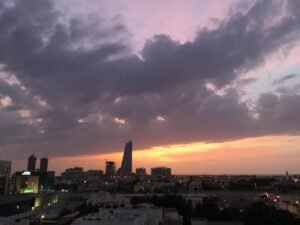
Running in Jeddah taught me that getting to know a city sometimes starts with leaving the hotel before breakfast, putting on your running shoes and seeing where the morning takes you.
I went there for work. Running gave me a different view of the place: the Red Sea before the crowds arrived, quiet streets waking up, and familiar faces who began greeting me along my route.
It also taught me respect for heat and humidity. Arriving from a cold European morning, I soon discovered that my usual pace had not travelled quite as comfortably as I had.
A business trip, with running shoes
During my career in international sales, I travelled to countries and cities I probably would never have visited as a tourist. My running kit usually came with me.
Usually.
Once, I forgot it. My first reaction was to blame someone, which was difficult because I had packed the bag myself. Fortunately, there was a Nike outlet five minutes from the hotel. Suddenly, forgetting my running clothes became an excellent excuse to buy new ones.
On most trips, though, the routine was simple: get up early, put on my shoes and explore.
This did not always produce a beautiful route. Sometimes I found industrial estates, traffic and stretches of pavement that made me question my judgement. Occasionally, a stray dog joined me. Some looked friendly. Others looked as though they were assessing the breakfast options.
Then, the next morning, I might discover a park just down a side road.
That was part of the enjoyment. Each run helped me understand a little more of the city.
The Jeddah I discovered on foot
My memories of running in Jeddah stretch from my first visit in 2003 to later stays, including 2017. The city changed considerably between those visits, and these routes describe my experiences at the time. Access, landmarks and conditions may have changed since.
On an early visit, I stayed near the port and explored the waterfront around the area marked on maps as 40th Lake. From there, I could continue towards the older parts of town.
I enjoyed the contrast: busy streets, small shops, trading activity and buildings that gave the city its character.
Later visits took me further north, where wide roads, newer developments and the Corniche offered a different running experience.
There were modern hotels and unfinished towers, villas behind boundary walls, and bright bougainvillea against beige buildings. Jeddah had its own appearance and atmosphere. I enjoyed noticing the details at running pace.
Long runs along the Corniche
The Corniche became my regular choice for longer runs.
I often started near Sparky’s amusement park and followed the waterfront south, with the Red Sea on my right. Depending on where I started and turned around, I could build a long out-and-back run without repeatedly circling the same block.
There was plenty to look at: mosques appearing to stand over the water, hotels, palm trees and broad stretches of waterfront.
The first time I reached the newer waterfront areas, I was pleasantly surprised by the space. It was the kind of place where a training run could become a sightseeing trip.
You could set off determined to maintain a steady pace, then find yourself stopping for a photograph.
I spent many mornings covering roughly half-marathon distance along this stretch. The ground was flat, the route was straightforward, and I could settle into a rhythm.
The atmosphere depended on when I went. Early mornings could be quiet, while Fridays and public holidays brought families, picnics and a much livelier waterfront.
Fair enough. Their picnic did not need a sweaty runner charging through the middle of it.
The people made the route
What stayed with me most was how people began to recognise one another.
Regular runners exchanged greetings. Different nationalities, different backgrounds, all out there doing the same thing before the day became too hot or too busy.
I met Filipino runners whose friendliness made an impression on me, and saw groups finding their own ways to make running part of life in Jeddah.
Then there were the street cleaners.
On some routes, I passed the same workers each morning. They would see me approaching, smile and give me a nod. Before long, those greetings became part of my routine.
If someone was missing, I noticed.
Had I come past earlier than usual? Was he working somewhere else that morning?
They were small encounters, but they made an unfamiliar city feel more familiar. They also gave me perspective. I was outside for a run before returning to my accommodation. These men had a working day ahead of them in the heat.
Shorter routes closer to home
The Corniche was not always practical. Getting there and back took time, and some mornings I wanted to finish my run close to where I was staying.
During a longer assignment, I found a small neighbourhood park about 200 metres from my furnished apartment. One lap was approximately 400 metres.
Nothing spectacular. No sweeping sea view. But very useful.
I could run repeated laps without crossing roads or thinking about directions. Twenty laps gave me a decent session, and afterwards I was almost home already.
A simple route can be a great advantage when you are travelling. There is less preparation, less uncertainty and less opportunity to talk yourself out of going.
I also explored the Al-Rehab walkway and other local exercise areas. One route came with a particularly serious temptation: a nearby Cheesecake Factory.
I can recommend the running experience. My judgement about what happened afterwards may have been influenced by the cheesecake.
Exploring beyond the waterfront
Another place I visited was the area I knew as the Eastern Forest, or Jeddah National Park, east of the airport.
At the time, it felt unfinished and unusually quiet. There were trees and roads, but little of the activity I associated with a busy city park.
For running, that quietness had its appeal. I also knew it as a location used for a local half-marathon event.
It was a reminder that an interesting route does not always have to be a famous one. Sometimes the attraction is simply having space to run.
For anyone following in my footsteps, treat these place names as starting points for checking a current map and asking local runners about access.
The familiar 10-kilometre loop
One of my regular training routes was a roughly rectangular loop of about 10 kilometres.
It followed long, straight sections through neighbourhoods near landmarks such as the Midas furniture store and Red Sea Mall. Over time, I learnt its turns, crossings and distances.
I knew where I would see the first street cleaner. I knew which stretches would be quiet. And I knew where the sunrise might catch me.
There was something special about turning east as the sun began to appear.
Some mornings, I wanted to stop and take a photograph. Usually, I found the experience better than the picture. A phone could capture the sky, but not quite the feeling of being there, moving through a city that was only beginning its day.
As I became familiar with the loop, it became useful for more structured training. I could recognise sections by feel and pay closer attention to my effort and rhythm.
That familiarity also helped me use mental rehearsal. Away from the road, I could picture the route clearly because I had already run it so many times.
What the heat taught me
Jeddah challenged my expectations.
A pace that felt manageable in Europe could feel very different in the heat and humidity. Trying to force the same session simply because it appeared on my training plan was not a sensible measure of determination.
I had to adjust.
Early starts became part of my routine, but an early start did not make the conditions cool. I learnt to pay attention to the morning I actually had, rather than the one I wished I had.
Mental training helped me approach that adjustment with less frustration. It did not remove the heat or make physical limits disappear.
Confidence, for me, meant being willing to adapt the session and still recognise its value.
How I used mental rehearsal
Travelling gave me plenty of time in airports and on flights. I began using some of that time for short mental rehearsal sessions.
I pictured a familiar route: leaving my accommodation, settling into the opening stretch, reaching a turn and finding a comfortable rhythm.
I also imagined responding calmly when things did not go to plan.
Perhaps the road was busier than expected. Perhaps my legs felt heavy. Perhaps the conditions called for an easier or shorter run.
The aim was to prepare a useful response instead of spending the whole session arguing with reality.
I knew how quickly imagination could make an unfamiliar situation feel worse. Years earlier, while running in South Korea, I had become thoroughly lost. I could not make sense of the street signs, had lost my bearings and briefly wondered whether I would ever see my hotel again.
Obviously, I found it.
But I remembered the feeling. Mental rehearsal gave me a way to practise approaching uncertainty more calmly.
What I brought home from Jeddah
Running gave me more than training mileage during those assignments.
It gave me a routine when work and travel were unpredictable. It helped me find my way around. And it introduced me to people I might otherwise have passed without noticing.
I remember the waterfront and the sunrise. I also remember the small park near my apartment, the familiar turns of my morning loop and the nod from a street cleaner who recognised me coming down the road.
Those details made Jeddah part of my running life.
If you travel with your running shoes, you may recognise the feeling. A city stops being just a hotel, an office and a journey between the two. You begin to know a few streets, a few faces and a small part of its daily rhythm.
For more of my running stories, books and thoughts on mental training, visit heikostribl.com.
Take it easy. God bless you.