Swimrun Stories, Part 2
ÖTILLÖ Engadin taught me more about breathing than any pool ever did. If you’ve ever jumped into a mountain lake, you know the moment. The cold hits your chest, you gasp, and for a few seconds your body forgets how to breathe. Now imagine that moment, again and again, in a race.
If you’re a runner who’s nervous about open water, this is the story for you.
ÖTILLÖ Engadin: a race through the mountains
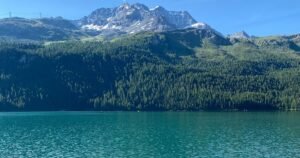
The Engadin in Switzerland is one of the most beautiful places I have ever raced. Mountains, larch forests and alpine lakes so still they mirror the peaks around them. The route links trails and lakes together: you run through the valley, wade in, swim across, climb out and run again.
It looks like a postcard. It feels like an ice bath.
The gasp
Cold water triggers a reflex. You breathe in sharply, your heart rate shoots up and your breathing becomes short and fast. Many swimmers panic in that moment. Not because they can’t swim, but because they can’t breathe.
Runners are especially vulnerable here. On land, when you’re out of breath, you breathe harder. In the water, that makes it worse. Short, panicked breaths mean you never fully empty your lungs, and you start every new breath already short of air.
Breathe out, not in
One of the most important lessons in the book From Runner to Efficient Swimmer: Master the Crawl is this: the problem is usually not breathing in. It’s breathing out.
Breathe out calmly and steadily underwater, through your nose or mouth, the whole time your face is in the water. Then, when you turn to breathe, your lungs are empty and ready, and the in-breath happens almost by itself.
At ÖTILLÖ Engadin, every lake started the same way: the shock, the gasp, and then a conscious decision. Slow down. Breathe out. Long, calm bubbles. After a few strokes, the panic had nowhere to go, and the cold became something I could handle.
How to get used to cold water
- Get in slowly. Wet your face and neck before you start swimming. Give the reflex time to pass.
- Count your out-breath. Breathe out for three or four strokes. Counting gives your head something to do besides panic.
- Start easy. The first 100 metres decide the rest of the swim. Go slower than feels necessary.
- Practise before race day. A few short swims in cold water beforehand take away most of the shock.
Same secret, different setting
If you’ve read my articles about the Stelvio and Mont Ventoux, this will sound familiar. On the bike, the secret was a low heart rate. In cold water, it’s a calm breath. It’s the same principle: don’t let the first shock decide how the rest of your race goes. And as I wrote in Your Brain Is the First Thing That Quits, the alarm in your head is usually louder than the danger.
What I took away from ÖTILLÖ Engadin
- The cold-water gasp is normal. Expect it, and it loses its power.
- Breathe out fully underwater, and the in-breath takes care of itself.
- Slow down for the first strokes of every swim. Speed comes once your breathing settles.
- Calm beats fast, in the water and on the trail.
One honest thing about that calm breath in the Engadin lakes: it wasn’t found on race day. It never is. When the cold hits your chest, there’s no time to think, and your body does whatever it has learned to do. If it has learned to grab short, panicked breaths, that’s what you’ll get, however many articles you’ve read. If it has learned to breathe out calmly under water, that’s what takes over instead. The difference is training: an established process where breathing is practised standing still first, then turning to breathe, then swimming short distances, then longer ones, each step only when the one before feels easy. Repeated like this, calm breathing moves out of your head and into your subconscious, where it’s still there when the cold water tries to take it away. That’s exactly how breathing is learned in the book From Runner to Efficient Swimmer: Master the Crawl. Calm in cold water isn’t a talent. It’s prepared long before you wade in.
Missed Part 1? Read ÖTILLÖ Malta: Swimming in Running Shoes. Next in the series: La Manga in Spain, a race between two seas, and the friend I made along the way.
Take it easy, and God bless.
— Heiko